
Find places to visit in Britain by name, location, type of attraction, or other keyword.
This listings directory is being phased out, to be replaced with ‘Places to Visit’. You may find what you are looking for there.
Tap/Click ‘find listings’ for a detailed search – or just have a browse.

The Queen's Chapel of the Savoy is all that remains of the Savoy Hospital founded by Henry VII, which stood on site of the earlier Savoy Palace, sacked during the Peasants' Revolt of 1381. It is a private royal chapel of His Majesty The King and not subject to episcopal jurisdiction. It is part of the Savoy Estate, the Duchy of Lancaster’s principal London land holding. Since 11 May 1937, by command of King George VI, it has also been the Chapel of the Royal Victorian Order.

The Chiding Stone is a block of smooth sandstone which allegedly (but probably not) gives the village of Chiddingstone in Kent its name and which has a mysterious past. One story is that it was used as a place of judgement in ancient times - hence 'chiding stone'. The village is a peach - most of the buildings are owned by the National Trust and are over 200 years old.
Chiddingstone is located on a minor road between Edenbridge and Tonbridge; the River Eden flows just to the north.
Nr Edenbridge

Saxonbury is a much eroded and worn univallate hillfort dating from the late Bronze/early Iron Age, with a curious 19th century folly in the centre. The hillfort is located in woodland in the Weald of East Sussex a short distance from the A267, where there is a convenient layby just north of Danegate. The earthworks are clearly visible and excavations in the last century suggested that iron might have been produced there. They also revealed evidence of an earlier prehistoric enclosure. The fort is on the Eridge Park Estate owned by the Nevill family since 1448 and the folly was built by Henry Nevill, 2nd Earl of Abergavenny in 1828. I think it looks like a rocket. A telecoms company currently uses it as a communications mast. It would be interesting to know the etymolgy of 'Saxonbury' - it suggests a defended place in later times?
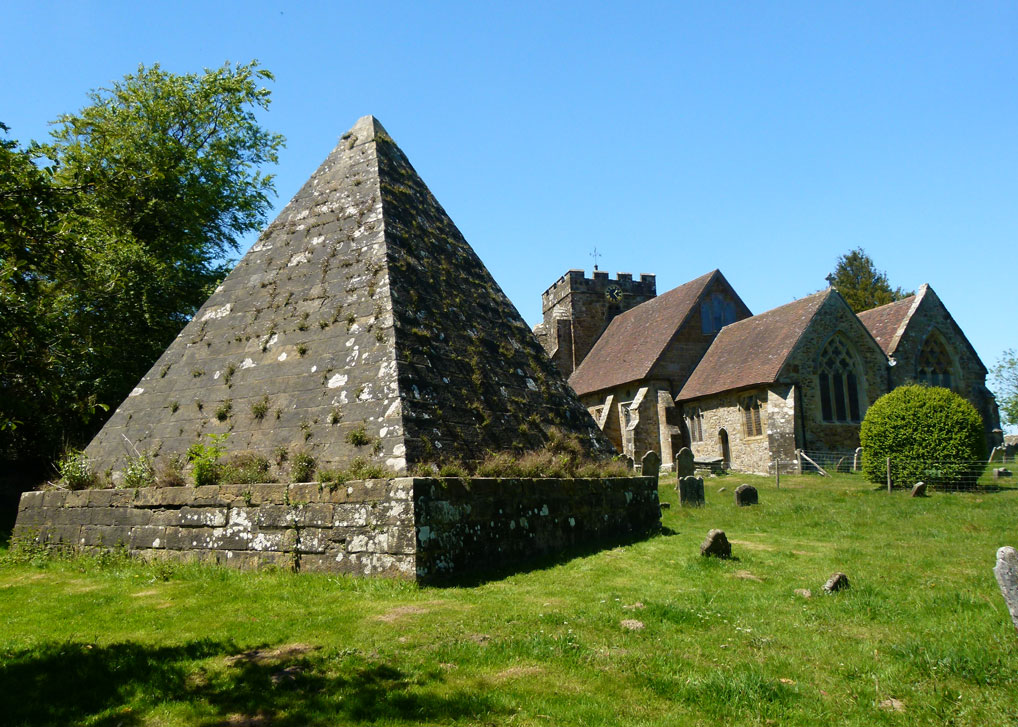
Brightling is a tiny village in the Weald, surrounded by lovely countryside and other tiny villages. There are two reasons you might want to visit. Firstly, it has an attractive church, dedicated to St Thomas à Becket, which was actually mentioned in the Domesday survey. So, given that Thomas was murdered in 1170, the church was obviously originally dedicated to someone else, possibly St Nicholas. The current building dates from the 13th century and among its features are some good brasses, 17th century wall paintings (biblical texts) and a rare barrel organ. The second reason to visit Brightling is to see the large stone pyramid in the churchyard. This was built as a mausoleum for John ‘Mad Jack’ Fuller (1757-1834), the local squire. Fuller was an eccentric, drunk, Member of Parliament, plantation and slave owner, philanthropist, patron of the arts and science (he supported JMW Turner and Michael Faraday) and builder of follies. Local legend was that he had been buried in his pyramid seated at a table in full evening dress with a bottle of claret but, sadly, that was shown to be untrue. Among his other structures are a ‘temple’ in the grounds of his house, Rosehill (now Brightling Park) next door to the church, an observatory (now a private residence), an obelisk on a local hilltop, ‘sugar loaf’ (no idea, sorry) and a tower – which is easily accessible a short walk across fields south-east of the church.
Brightling

Bunners describes itself as a traditional ironmonger, which it is; but it is so much more too. In addition to the things you would expect, such as tools, brackets, hinges, paint and brushes, it sells toys, kitchenware and gifts. It sells stoves and garden equipment. Even fuel. It has an enormous range. Established in 1892, Bunners is still a family business and, inside, it is a little like stepping back in time. There is a traditional shop counter with friendly, helpful, staff who know their stock. You can still buy a single screw, rather than a pack of 10 or more. Beyond the counter, the place is something of a rabbit warren and, frankly, worth exploring for the experience and education.
Montgomery

Thames House has been headquarters of the UK's Security Service, or MI5, since 1994. Clearly, the building is not open to the public and unwanted visitors will politely be asked to leave.
From MI5's website: "The role of MI5, as defined in the Security Service Act 1989, is "the protection of national security and in particular its protection against threats such as terrorism, espionage and sabotage, the activities of agents of foreign powers, and from actions intended to overthrow or undermine parliamentary democracy by political, industrial or violent means"."
Exbury Gardens were the creation of wealthy Victorian banker, Lionel Rothschild. There are 200 acres to explore, along the bank of the Beaulieu river in the New Forest. Exbury is famous for its rare trees and, in the spring, its collection of rhododendrons, azaleas and camellias. There is also a 12.25 inch gauge railway to ride on, if you're so inclined.
You will find Exbury on a minor road south of the B3054 between Hythe and Beaulieu.
Southampton
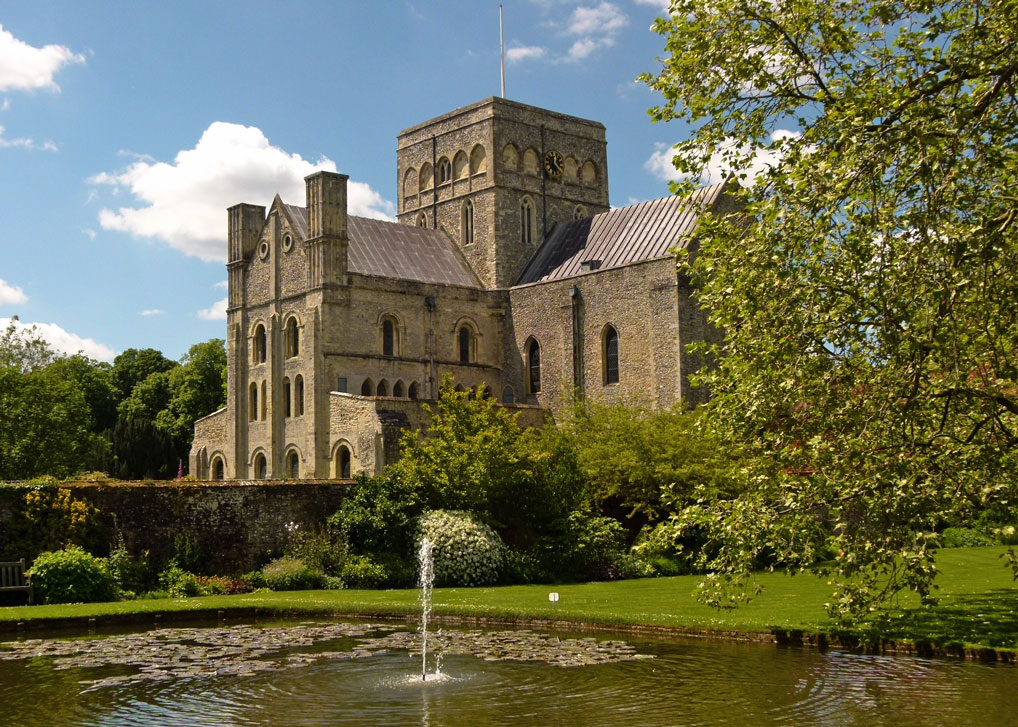
The The Hospital of St Cross and Almshouse of Noble Poverty was founded as a hospital for the poor between 1132 and 1136 by Henry of Blois, Bishop of Winchester, grandson of William the Conqueror and younger brother of King Stephen. Endowments enabled it to prosper and provide. In 1445, another powerful Bishop of Winchester, Cardinal Henry Beaufort, created the Order of Noble Poverty, and added the almshouses to the existing Hospital buildings. It continues to provide homes to twenty five brothers, who wear distinctive black or claret coloured robes. Visitors are able to see the Norman style church, Master’s Garden – and there is a teahouse and shop. The Hospital of St Cross is famous for the Wayfarer’s Dole - a horn of beer or ale with a piece of white bread given to any traveller that asks for it.
By far the best way to visit the Hospital of St Cross is on foot from Winchester Cathedral Close, through ancient gateways, past No 8 College Street, where author Jane Austen finished ‘Persuasion’, and died, turning right by Winchester College to the water meadows alongside the River Itchen. The path is wide, well trodden and wonderful. Keats enjoyed the same walk – it apparently inspired the ode ‘To Autumn’, written in 1819. To the right are the immaculate playing fields of Winchester College, founded in 1382 by William of Wykeham, Henry Beaufort’s predecessor as Bishop of Winchester. Its pupils are known as Wykehamists and the college motto is 'Manners Makyth Man' – the same as New College, Oxford, which was also founded by Wykeham. To the left are the water meadows, cattle-grazed and seeming to lap against the contours of St Catherine’s Hill, site of an ancient univallate Iron Age hillfort and medieval chapel. It is an immensely peaceful pathway, steeped in history and, somehow, very English. On a still, warm, June day, with the rich earthy scent of the riverbank wafting upward and the water sparkling and lapping nearby, it is almost heavenly. And, eventually, you will glimpse the hospital, like a scene from the past across a field.
Winchester

St Bartholomew's Hyde is the 12th century parish church of Hyde, once a village now a suburb of Winchester. The church is situated opposite the remaining gatehouse of Hyde Abbey, founded in 1110 and dissolved in 1538/9. The church stands within what were the abbey’s precincts to serve the needs of its tenants and lay officials. It is a flint and stone building with a tower built in 1541 using stones from the demolished abbey; the church was much restored in the 19th century. A collection of capitals from the abbey is on display inside. Outside, at its eastern end, is a plain slab grave marking a collection of bones from six medieval individuals once thought to have included King Alfred of Wessex, Alswitha and their son King Edward.
Hyde
Winchester

The SIS Building at Vauxhall Cross has been the headquarters of the Secret Intelligence Service, popularly known as 'MI6', since 1994 - and quickly became one of London's most recognised buildings, featuring in many movies. Obviously, it is not open to the public and unexpected visitors are discouraged.
From the website of the SIS: "At the Secret Intelligence Service (SIS) – otherwise known as MI6 – our mission is clear. We work secretly overseas, developing foreign contacts and gathering intelligence that helps to make the UK safer and more prosperous. We help the UK identify and exploit opportunities as well as navigate risks to our national security, military effectiveness and economy. We work across the globe to counter terrorism, resolve international conflict and prevent the spread of nuclear and other non-conventional weapons. We are here to help protect the UK’s people, economy and interests."
85 Albert Embankment
Lambeth
If your favourite attraction is not listed yet, and you have a good quality digital photograph of it that you are able to freely send, please get in touch.